

- Why Bournemouth Lofts Suit Grey Squirrels
- Why Winter Is When Squirrels Move Into Lofts
- How to Tell If It Is Squirrels in Your Loft
- The Damage Squirrels Cause in a Loft
- What the Law Says About Grey Squirrels
- Why Blocking the Hole Is Not the First Step
- What You Can Do Now
- How Professional Squirrel Control Works
- Getting Help With Squirrels in Bournemouth
- Frequently Asked Questions
If you hear scratching, running or gnawing above the ceiling as it gets light on a winter morning, there is a good chance a grey squirrel has found its way into your loft. It is one of the most common reasons Bournemouth homeowners look for pest control in Bournemouth at this time of year.
Squirrels in a loft are more than a noise problem. They chew timber, cables and insulation, and once one has found a way in, others often follow. This guide explains why it happens, why winter matters, and what actually stops it.
Why Bournemouth Lofts Suit Grey Squirrels
Grey squirrels do best where trees, gardens and buildings sit close together. Much of Bournemouth fits that description.
Trees, Chines and Parks Close to Houses
Bournemouth is known for its pines, and many residential streets have mature trees in front gardens and along boundaries. The wooded chines running down to the seafront, along with green spaces such as Meyrick Park, Queen’s Park and Talbot Woods, give squirrels food and cover right next to housing.
A squirrel living in a garden tree does not need to travel far to reach a roof. Overhanging branches, ivy, fences and drainpipes act as ladders, and grey squirrels can jump well over a metre from a branch onto a roof edge.
Older Roofs With Plenty of Gaps
Large parts of Westbourne, Boscombe, Winton and Charminster are made up of Victorian and Edwardian houses, many now split into flats. Older roofs tend to have more weak points: timber fascias and bargeboards that have softened, slipped or missing tiles, gaps where extensions meet the original roofline, and open gable vents.
Squirrels do not need a large hole. They test weak timber and gaps with their teeth, and a small opening can be chewed wide enough to get through in a short time.
Why Winter Is When Squirrels Move Into Lofts
Grey squirrels do not hibernate. They stay active all winter and rely on food they buried in autumn, so they need somewhere warm and dry to rest between feeds. A tree drey made of twigs and leaves offers some shelter. A loft full of insulation offers far more.
Timing also matters for breeding. Grey squirrels usually mate from around December into February, and the first litters are born in late winter and early spring. Pregnant females look for safe, sheltered nest sites, and a quiet loft is ideal. A squirrel you hear in December may be preparing a nest that will hold young by March.
This is why winter is the right time to deal with the problem. Once young are in the loft, removal becomes more complicated and the risk of animals being trapped inside increases.
How to Tell If It Is Squirrels in Your Loft
Our guide to the signs of squirrels in your loft covers this in detail. The short version is to pay attention to when you hear the noise.
Squirrels are active during the day. Noise usually starts around first light, quietens through the middle of the day and picks up again in the late afternoon. Activity is often loud: running, thumping and rolling sounds as they move nuts or nesting material.
Rats and mice are mainly active at night. If the noise is mostly after dark, a rodent is more likely, and rodent control needs a different approach. Birds nesting under the eaves are mostly a spring and summer issue, and the sound usually comes from the roof edge rather than across the loft floor.
Other clues of squirrels include:
- Shredded insulation pulled into a heap or nest
- Gnawed timber, especially around the entry point
- Droppings that are larger than mouse droppings and more rounded at the ends than rat droppings
- Staining on ceilings below where they nest
- Squirrels seen going in and out at the same point on the roof
The Damage Squirrels Cause in a Loft
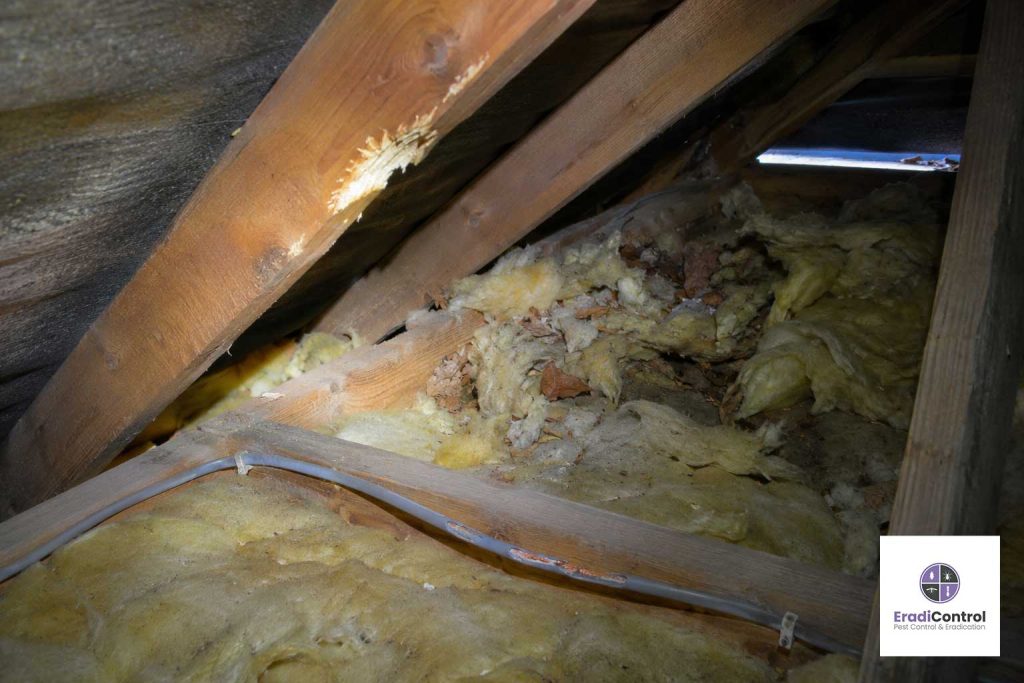
A squirrel’s front teeth grow throughout its life, so it gnaws constantly. In a loft that means:
- Electrical cables. Chewed insulation on wiring is a fire risk and is the most serious concern.
- Roof timbers. Rafters, joists and fascias can be gnawed, particularly around entry holes.
- Insulation. Torn and flattened insulation loses much of its effect, and it is often fouled with urine and droppings.
- Pipes and tanks. Plastic water pipes and tank lagging can be damaged, leading to leaks.
- Stored belongings. Boxes, fabrics and anything soft may be shredded for nesting.
Squirrels also cause indirect problems. An enlarged entry hole lets in rain, and an open gap can be used later by birds, rats or a different squirrel.
What the Law Says About Grey Squirrels
The grey squirrel is a non-native invasive species in the UK. That affects what can and cannot be done.
- They cannot be released. It is illegal to release a grey squirrel into the wild once it has been caught. Catching one in a cage trap and letting it go in a park or on the edge of town is an offence, not a humane alternative.
- Captured squirrels must be humanely dispatched. Any trapped animal is also protected from unnecessary suffering under animal welfare law, so traps must be suitable, set correctly and checked regularly.
- Poisons are not an option. Rat and mouse poisons are not approved for squirrels, and using a product in a way its label does not allow is an offence. In a loft, a poisoned animal is also likely to die somewhere you cannot reach.
Red squirrels are fully protected, but they will not be the squirrels in a Bournemouth loft. In Dorset, red squirrels survive mainly on Brownsea Island in Poole Harbour. Any squirrel in a mainland loft will be a grey.
Why Blocking the Hole Is Not the First Step
The natural reaction is to go up a ladder and block the gap. While squirrels are still using the loft, that usually makes things worse.
A squirrel shut inside will chew its way out, often through a different, weaker part of the roof, or into the house itself. If young are inside, they will die and the smell can last for weeks. A blocked squirrel may also start gnawing more urgently at timbers and cables.
The right order is:
- Confirm what is in the loft and how many animals are involved.
- Find every entry point, not only the obvious one.
- Deal with the squirrels already inside.
- Proof the roof once the loft is clear.
Proofing only works properly once you are sure nothing is left inside.
What You Can Do Now
There is plenty a homeowner can do safely while the problem is assessed:
- Cut back overhanging branches so they are at least a couple of metres from the roof. This removes the easiest route up.
- Check the roofline from the ground with binoculars if needed. Look for chewed fascia corners, missing tiles, gaps at the eaves and damaged vents.
- Keep loft access closed and avoid disturbing an active nest, particularly from late winter onwards.
- Do not feed squirrels near the house. Bird feeders that squirrels can reach draw them in close.
- Look at the loft wiring if you can do so safely. If you see chewed cables, have an electrician check them.
What you should avoid is DIY trapping without the right knowledge. Trapping squirrels in a loft is legal for a householder, but the welfare rules, the ban on release and the need for humane dispatch mean it is rarely straightforward in practice.
How Professional Squirrel Control Works
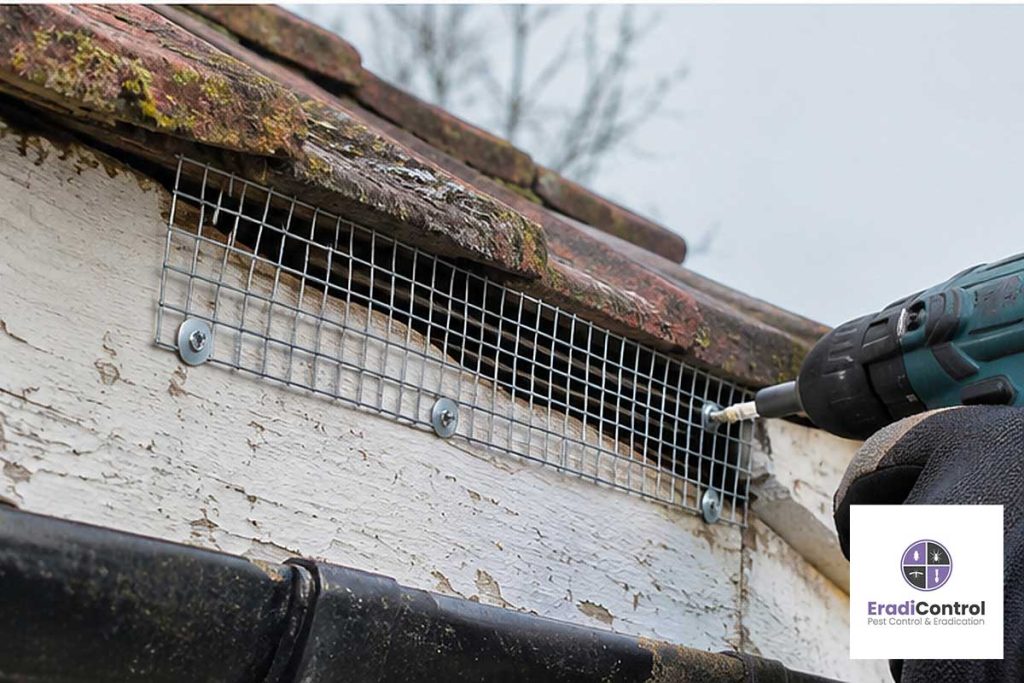
Professional squirrel control follows the same order as above, but with the experience to do each stage properly.
A survey comes first. The technician inspects the loft and the outside of the roof to confirm squirrel activity, find the entry points and look for nests or young. This also shows whether any damage needs attention, such as chewed wiring.
Treatment depends on what is found. The aim is to clear the loft humanely and within the law, using methods that suit the property and the time of year. Traps are placed where they will work and where pets, children and non-target animals cannot reach them, and they are checked as the law requires.
Proofing is the final stage. Entry points are sealed with materials squirrels cannot chew through, such as galvanised mesh, and weak areas of the roofline are dealt with. Without proofing, the loft will often be reoccupied, because the smell and nesting material left behind are an open invitation to the next squirrel.
Getting Help With Squirrels in Bournemouth
If you are hearing activity in the loft or have seen squirrels using your roof, it is worth acting before the breeding season gets going. Dealing with the problem in early winter is usually simpler than in spring, when there may be young to consider.
Our Bournemouth pest control team covers homes across the town, from Westbourne and Winton to Charminster, Boscombe and Kinson. We explain what we have found and what we recommend before any work starts, and our pricing is clear from the outset. Same-day appointments are available until we are fully booked.
Frequently Asked Questions
Listen for when the noise happens. Squirrels are active by day, especially around dawn and late afternoon, and sound heavy and busy. Rats and mice are mostly heard at night. Droppings, gnaw marks and where you see animals entering the roof will help confirm it.
You can make the roof less accessible by cutting back branches and spotting gaps. Removing squirrels that are already inside is harder. Grey squirrels cannot legally be released, trapped animals must be dispatched humanely, and blocking entry points too early can trap squirrels inside, so most people find professional help safer and more effective.
No. Grey squirrels are an invasive non-native species, and releasing one into the wild after capture is illegal. A caught grey squirrel must be humanely dispatched.
Yes. Squirrels gnaw constantly to keep their teeth in check, and cable insulation is a common target in lofts. Exposed wiring is a fire risk, so if you find chewed cables, have them checked by an electrician.
Once you are certain no squirrels are left in the loft. Proofing in autumn or early winter, before females look for nest sites, prevents the most problems. Proofing while squirrels are still inside can trap them and cause more damage.
Rarely for long. A squirrel may leave during the day to feed, but it will come back to a warm, dry nest. If young are born in the loft, they will be there for several weeks. Even when squirrels do move on, the nest and scent left behind attract others.
It varies. A single squirrel may use a loft as a winter shelter, but a breeding female can produce a litter of several young. A survey of the loft and the roofline is the only reliable way to judge what you are dealing with.
It depends on your policy. Some home insurance policies exclude damage caused by vermin or pests, so check the wording or ask your insurer. Either way, dealing with squirrels early limits how much damage there is to repair.
Usually a rounded mass of shredded insulation, leaves, paper or fabric, often tucked into the eaves or against a wall where it is sheltered. You may also see a trail of chewed material leading back to the entry point.
If you think squirrels have moved into your loft, get in touch and we will arrange a visit to find out what is up there and how they are getting in. Dealing with it now, before the breeding season, is usually the easier route.
 Domestic Pest Control
 Commercial Pest Control
 Eco-Friendly Pest Control
 Emergency Pest Control


Leave a Reply